
MR-710 “Top Plate”
Description of the radar set, tactical-technical characteristics
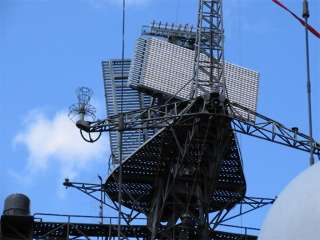
Figure 1: MR-710 “Top Plate”
(© 2015 Jörg Waterstraat www.kriegsschiffe.eu)
| Specifications | |
|---|---|
| frequency: | D/E-Band |
| pulse repetition time (PRT): | |
| pulse repetition frequency (PRF): | |
| pulsewidth (τ): | |
| receive time: | |
| dead time: | |
| peak power: | |
| average power: | |
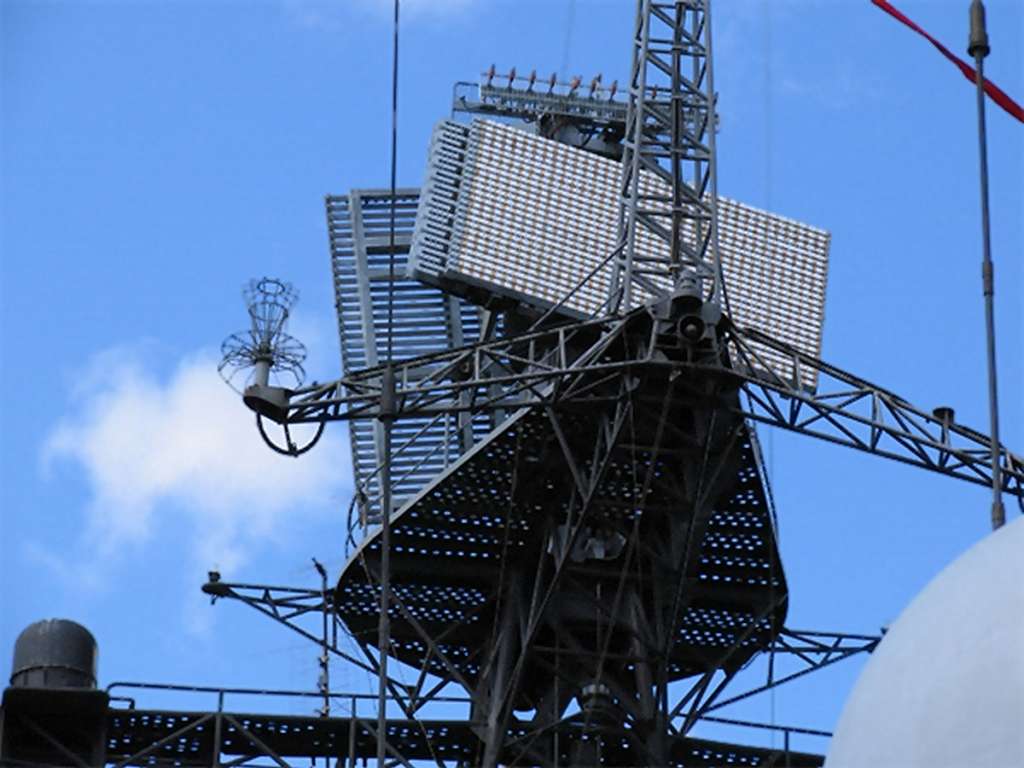
| instrumented range: | 150 or 300 km |
| range resolution: | |
| accuracy: | 120 m, 0.25° |
| beamwidth: | |
| hits per scan: | |
| antenna rotation: | 12 or 6 min-1 |
| MTBCF: | |
| MTTR: | |
MR-710 “Top Plate”
The MR-710 “Top Plate” «Fregat» («Фрегат») (meaning frigatebird) is an operating in D and E-Band air and surface surveillance radar for maritime use. It is a three-dimensional system which employs back-to-back antennas whose opposite antennas are optimized for two different frequency bands, which is why one antenna appears slightly smaller. The antennas are serially fed frequency scanning phased-array antennas. Since the frequency-dependent beam swiveling also affects the horizontal antenna rows, the resulting antenna beam swivels from bottom right to top left:i.e. diagonally. In order to compensate for this, the entire antenna face was rotated until the beam swiveling appears vertical again.